
The Broker Narrative vs. Developer Reality: Navigating San Diego’s Q1 2026 Multifamily Market
Introduction: Two Stories, One Market
If you read the quarterly reports published by the major institutional brokerage houses, the narrative surrounding the San Diego multifamily market feels predictable, structured, and safe.
The high-level data points from the likes of CBRE, Newmark, and Marcus & Millichap are well-aligned:
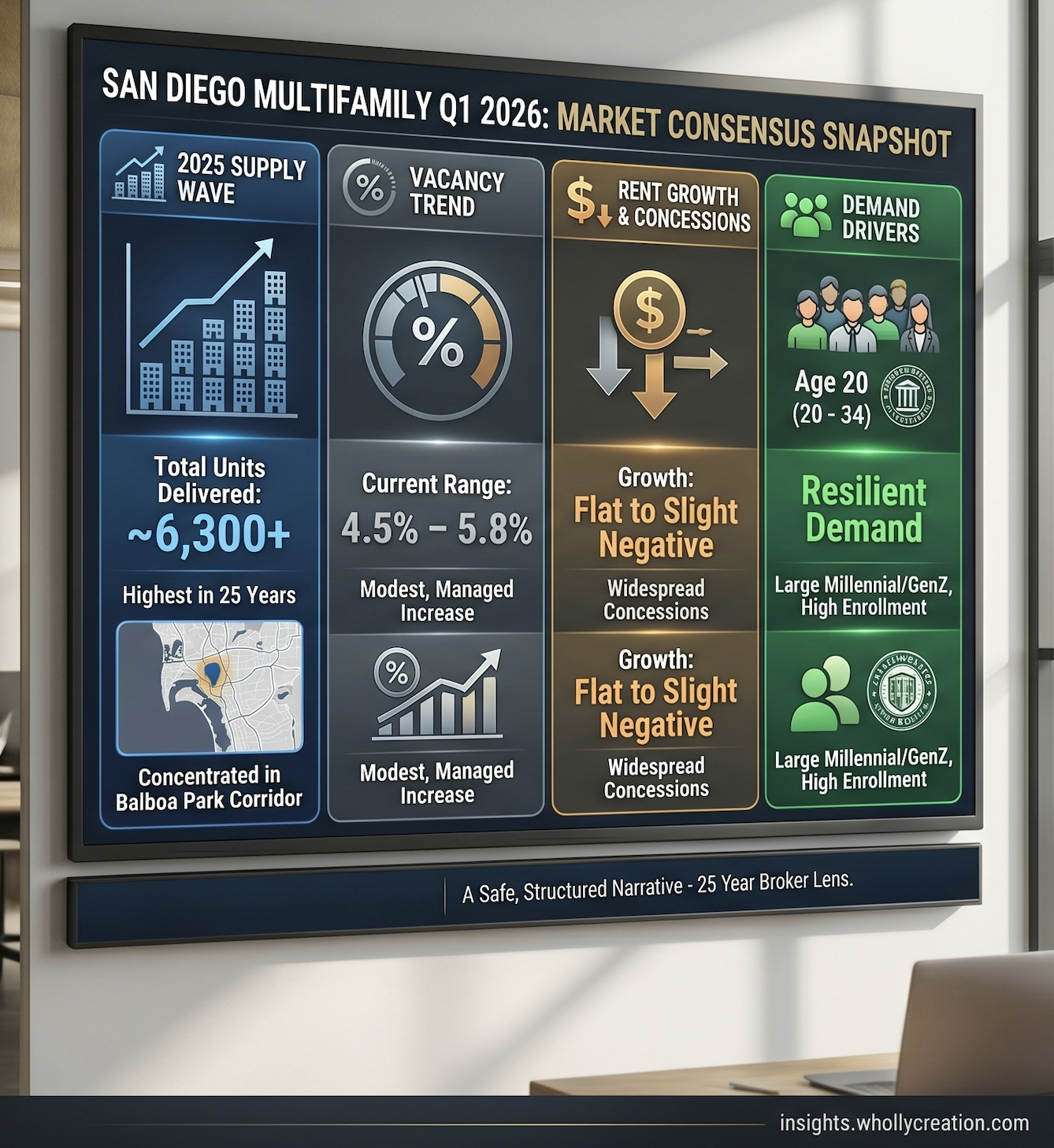
San Diego Multifamily Q1 2026:
The Supply Wave: 2025 delivered one of the largest supply waves in 25 years, pouring roughly 6,200 to 6,400 units into the market, heavily concentrated in the Balboa Park corridor and surrounding urban submarkets.
Vacancy & Rents: Vacancy has ticked up modestly into the 4.5% – 5.8% range, keeping rents flat to slightly negative with widespread concessions in new lease-ups.
Underlying Demand: Demand remains resilient, structurally supported by a massive 20-to-34 demographic, robust university enrollment, and steep, ongoing barriers to homeownership.
The Consensus Outlook: Expect a gradual stabilization through 2026 and 2027 as the pipeline of new deliveries naturally slows.
Having spent 25 years in the broker shoes producing exactly these types of institutional reports, I understand the value of this data. It is a good, safe narrative.
But as developers and investors, we do not operate on paper. We operate on the ground. And right now, the reality we face on the dirt looks entirely different.
From the Desk of Danny Fitzgerald
"The broker narrative is essential for understanding where a market has been. But a developer’s reality requires a more nuanced, numbers-driven, and soulful strategy to see where the market is going. Following the herd right now means inheriting risks that traditional models simply aren't pricing in."
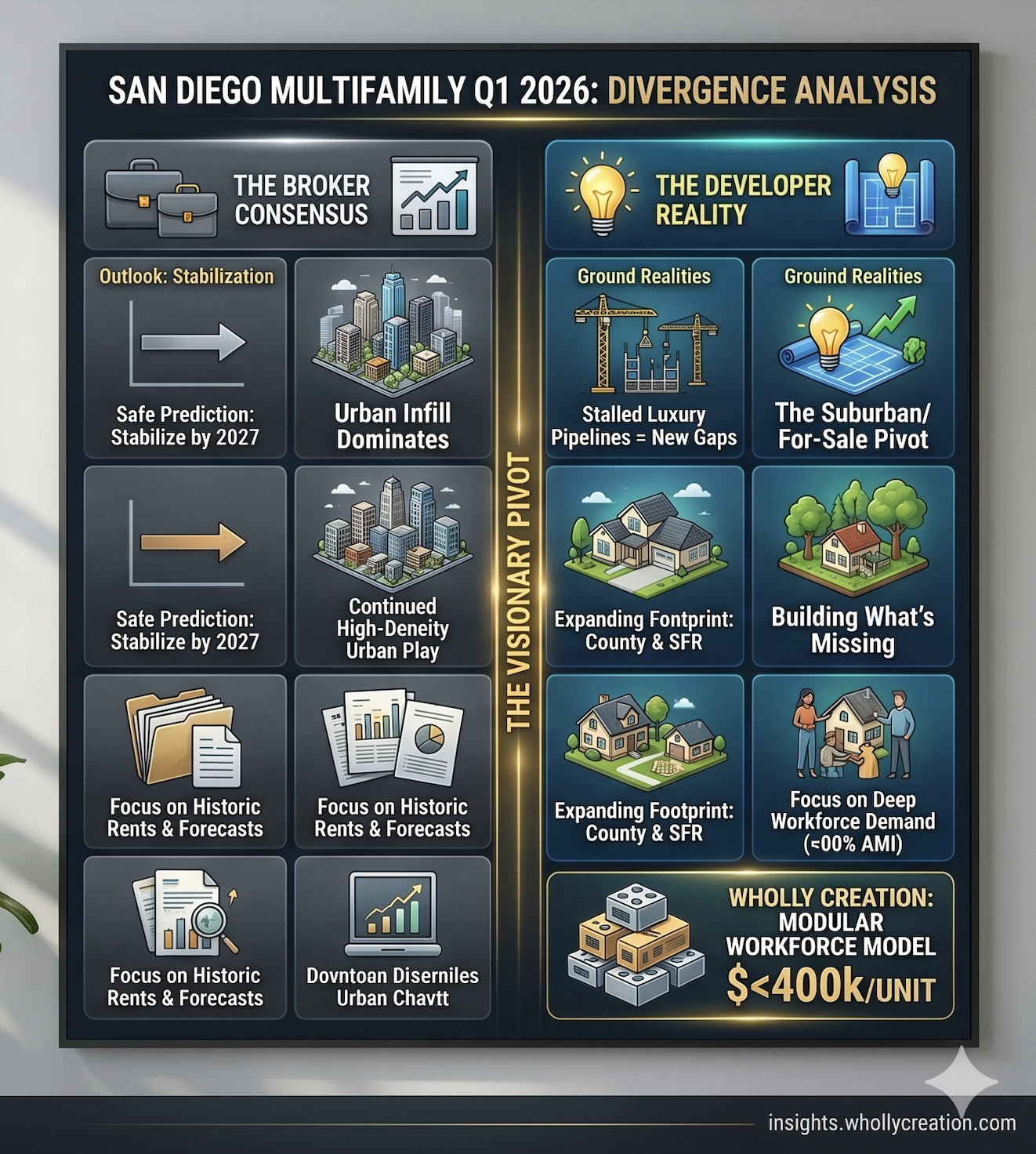
The Five Hidden Realities Shifting the Ground in San Diego
Beyond the surface-level reports, five systemic shifts are actively remaking the Southern California development landscape:
1. Policy is Manifesting in Real-Time
A decade or two ago, developers and city officials collectively agreed that archaic municipal codes and outdated local ordinances were fundamentally broken. The resulting Affordable, Sustainable, and Density Bonus programs were created as a toolkit to incentivize new development patterns. Today, those long-term policies are finally manifesting physically across the city.
2. Downsizing by Design
The softening of rents wasn't an accident—it was prescribed by design. Current policy and economic models favor high-efficiency living under 600 square feet with minimal to no parking. The dominant market headlines now center on healthier living, mixed-use community building, and urban models that deliberately serve lower-to-middle incomes outside of the traditional Downtown core.
3. The Speculation Freeze
San Diego caught the eye of the global investment community, sparking a massive influx of national and international capital. This intense excitement drove land values up 2X to 3X, skyrocketing from $\$100-\$150/\text{SF}$ toward upwards of $\$300-\$500+/\text{SF}$. This aggressive speculation has effectively stopped traditional underwriting in its tracks.
4. The Suburban and For-Sale Pivot
Recognizing the limitations of prolific high-density urban infill, municipalities across San Diego County and California are changing the pattern again. New incentives are shifting toward single-family rentals (SFR), suburban developments, and lower-density, for-sale housing. While urban infill won't die quickly, the outer cities are emerging as the new frontier.
5. The Impending Wave (2027–2030)
Top-down capital, politicians, and institutional pro formas have aligned on a singular play: Affordable and Workforce housing in high-income areas. Southern California faces an active 1-million-unit housing deficit. With the global spotlight of the World Cup and the Olympics arriving shortly, the demand for this asset class is effectively infinite.
The Catch: Volatility and the "Blend and Extend" Economy
If the macro-demand is so strong, why are groundbreakings stalling? Because transaction clarity has vanished.
Very few true, new-construction sale comps have successfully traded in the past 2 to 3 years. Without sales, lenders and investors struggle to accurately pin down exit values. Capital markets remain volatile and bid/ask spreads are wide. Instead of realizing losses or selling at a discount, sellers and lenders are choosing to "blend and extend" their positions into the next economic cycle.
This total lack of market clarity makes it incredibly difficult to underwrite new groundbreakings with confidence especially in an environment where near-term rents have softened and concessions remain elevated.
The Wholly Creation Edge: Building What They Won’t
Smart developers and investors are quietly shifting their playbooks to stay ahead of this curve. At Wholly Creation, we refuse to wait for the market herd to find its footing.
Our latest Q1 2026 Analysis backed by granular, unit-level lease-up comps and side-by-side pro forma modeling views today’s softening market not as a permanent roadblock, but as a call to innovate.
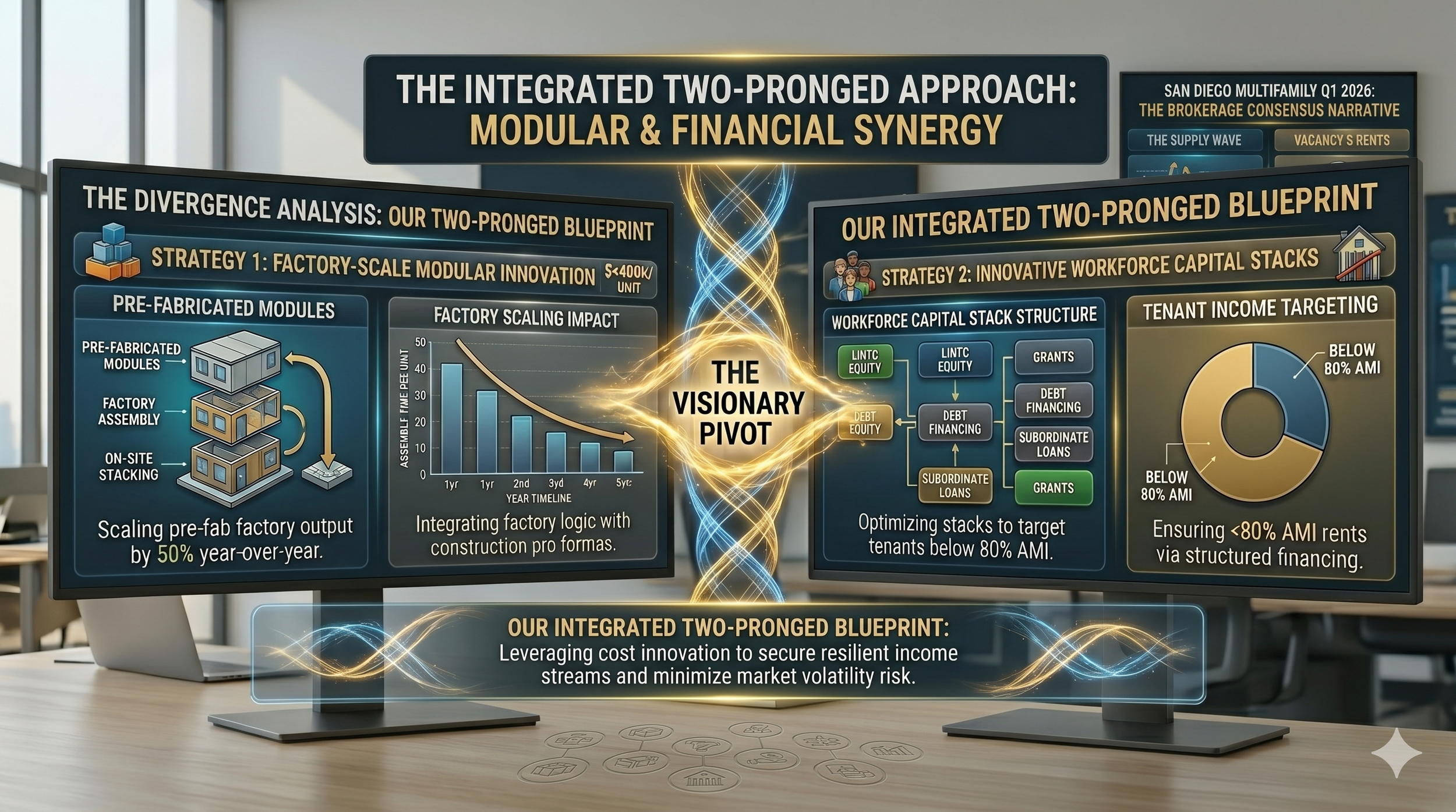
By intentionally driving toward what is missing, rather than over-building pure luxury, renter-by-choice products in saturated submarkets, we unlock fundamentally better risk-adjusted returns, stronger equity multiples, and true long-term sustainability.
When you build what the market actually needs, resilience is baked into the foundation.
⚡ Take Your Underwriting Beyond the Herd
The safest pro forma is the one built on real-time, asset-level execution not generalized forecasts.
⚡ Build What the Market is Missing
The standard broker narrative is safe, but market-disrupting returns require a strategy built on ground-level innovation. Whether you are a landowner looking to maximize asset value or an investor seeking resilient, high-yield workforce models, let’s underwrite the future together.
Partner with Wholly Creation to explore modular scaling and land optimization strategies for the next economy.
